


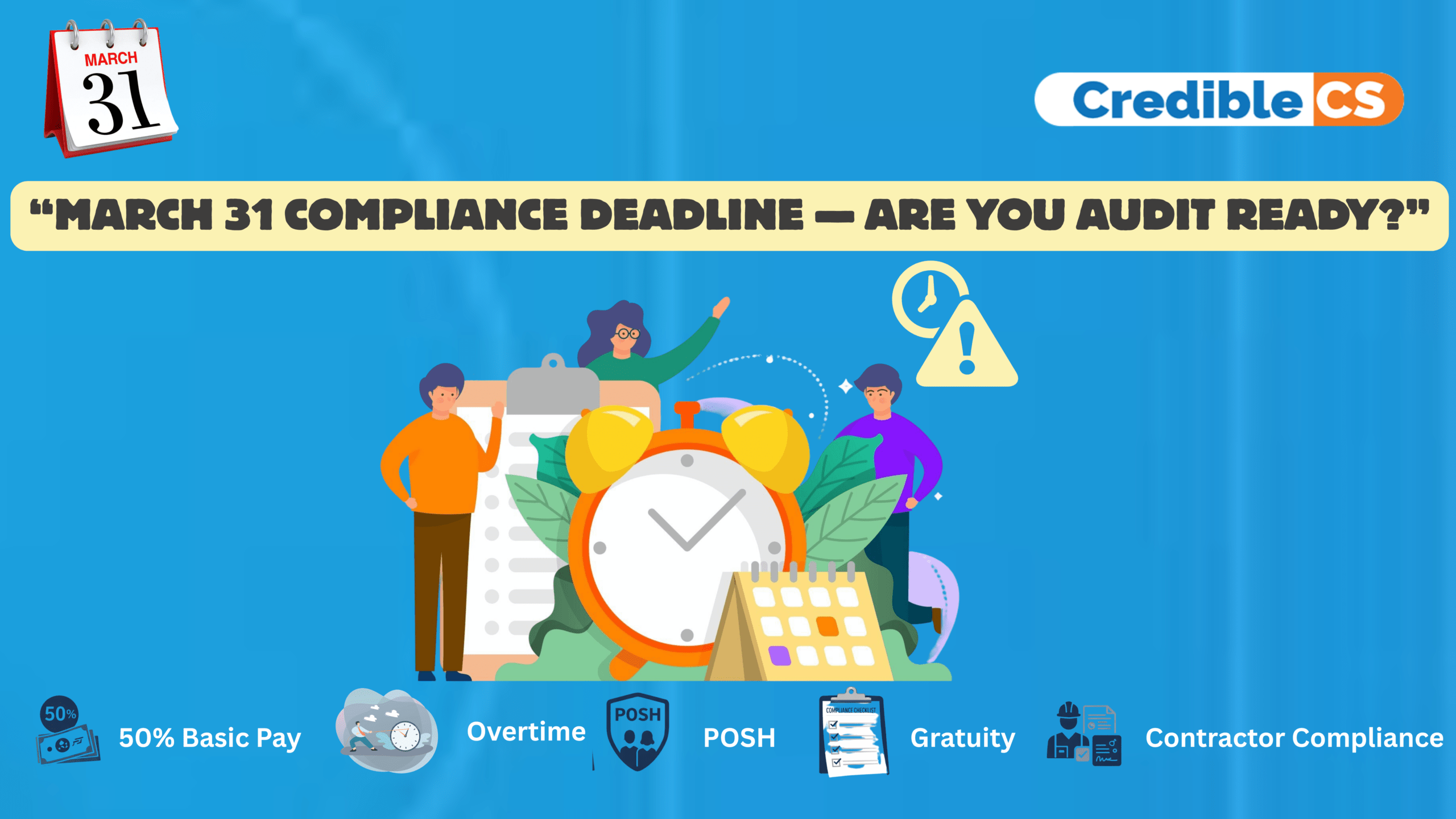
What Chennai Businesses Must Fix Before March 31, 2026
By Team of CredibleCS | Labour Law Compliance Specialist, Credible CS, Chennai
350+ Compliance Audits | Clients Across Ambattur, OMR, Guindy, Oragadam, Sriperumbudur | Last Updated: March 2026
Quick Answer — What does a year-end labour law audit cover?
A year-end HR compliance audit for FY 2025-26 covers seven critical areas: the 50% Basic Pay rule under the Code on Wages 2019, overtime double-wage calculations, Full and Final settlement within two working days, mandatory statutory register closure, gratuity eligibility for fixed-term employees (now one year, not five), POSH annual return filing, and contractor/principal employer liability verification. For Chennai businesses, March 31 is the effective compliance reset deadline before the new fiscal year begins. This labour law audit checklist for Chennai businesses is structured specifically around the March 31 financial year closure deadline and the enforcement trends seen in FY 2025-26.
1. Why March 31, 2026 Is a Different Kind of Deadline This Year
Last month, I walked into a manufacturing unit in Sriperumbudur for a scheduled compliance review. The payroll team was confident — they had been running the same salary structure for three years, processing PF and ESI without complaints, and filing returns on time. When we pulled the CTC breakdown, we found that basic salary sat at 28% of total remuneration. Allowances made up the rest.
Under the wage definition in the Code on Wages 2019, basic pay must constitute at least 50% of total remuneration. The company had been underpaying PF, miscalculating overtime, and understating gratuity liability — not through intent, but through inertia. The cost of correction, including backdated PF differentials and interest, was in the range of ₹6 to ₹8 lakhs for a workforce of 85 workers.
This is not an unusual story. In the last quarter alone, we identified the same structural issue across three factories in the Ambattur-Sriperumbudur corridor and two IT firms in OMR. What changed in 2026 is not the law — the Code on Wages has been in force. What changed is enforcement. The EPFO and Tamil Nadu Labour Department now cross-verify PF contributions against wage data digitally. Mismatches that were invisible in 2022 generate automated alerts in 2026.
March 31 is your last structured opportunity to identify and correct these gaps before the new financial year’s enforcement cycle begins. A proactive audit costs a fraction of what reactive remediation costs — and that fraction is the central argument of this guide.
2. What the New Labour Codes Actually Changed — and What Hasn’t Landed Yet
India’s four new Labour Codes — Code on Wages 2019, Code on Social Security 2020, Occupational Safety Health and Working Conditions Code 2020, and Industrial Relations Code 2020 — consolidate 29 central labour laws. Not all provisions are uniformly notified across states, and Tamil Nadu has its own implementation timeline. Understanding what applies now versus what is transitional is essential for accurate compliance assessment.
| Provision | Status in Tamil Nadu | Audit Action Required |
| 50% Basic Pay rule (Code on Wages) | Active — being enforced | Audit every employee’s CTC structure immediately |
| Overtime at 2x rate (Code on Wages) | Active — inspections target this | Recalculate OT base with new wage definition |
| F&F settlement within 2 working days | Active — litigation increasing | Test exit workflow with mock resignation |
| Gratuity for fixed-term employees (1 year) | Active — claims being filed | Provision in books for all fixed-term staff |
| Digital register maintenance | Recommended, not yet mandated | Migrate now — inspections favour digital |
| Unified annual returns (OSH Code) | Transitional — TN notifying | Continue existing returns + prepare for unified format |
| POSH annual return | Mandatory — district authority expects filing | Confirm ICC composition and annual report submitted |
Tamil Nadu minimum wages are revised periodically by state notification. The last revision must be compared against your current payroll for all employee categories. Download the current schedule from labour.tn.gov.in and cross-reference with your payroll register before closing FY 2025-26.
3. Step 1 — The 50% Basic Pay Audit (Your Biggest Exposure Area)
The 50% Basic Pay rule is the most widespread compliance gap we encounter in Chennai businesses, across all sectors. The reason is structural: salary architecture in India historically optimised for lower PF contributions and higher take-home pay by inflating allowances. That architecture is now non-compliant.
Under the Code on Wages 2019, the term ‘wages’ for PF, ESI, gratuity, and overtime calculation purposes must include basic pay and dearness allowance, and this combined figure must equal at least 50% of total remuneration. Excluded components are specific and limited: HRA, conveyance, special allowances, and certain other reimbursements can remain outside the 50% calculation — but only up to the 50% threshold. If excluded components collectively push basic below 50%, the entire structure is non-compliant.
What Non-Compliance Costs in Practice
The Sriperumbudur factory mentioned in the introduction — 85 workers, basic at 28% — faced three cascading consequences. First, PF shortfall: PF at 12% on ₹8,000 basic versus 12% on the compliant ₹14,400 basic. For 85 workers across three years, the differential plus 12% annual interest added up to approximately ₹6 lakhs. Second, overtime underpayment: overtime was calculated on the incorrect ₹8,000 base rather than the compliant ₹14,400, creating additional liability for every hour of recorded overtime across the period. Third, gratuity understatement: gratuity for five-year-plus employees was calculated on suppressed basic, creating a gap that surfaces when employees exit.
Your 50% Basic Pay Audit Checklist
Pull the complete payroll register for all employees — permanent, contract, and fixed-term — and calculate (Basic + DA) ÷ CTC for each
• Identify employees where this ratio is below 50% — these are your non-compliant salary structures
• Model the restructured salary: shift allowances to basic to reach the 50% threshold; recalculate PF, ESI, and gratuity projections for FY 2026-27
• Issue salary revision addendum letters to all affected employees documenting the structural change
• Update offer letters and appointment letters for new hires to reflect the compliant structure
• Recalculate overtime for the current financial year on the revised wage base and provision any underpayment liability
For IT firms in OMR and Sholinganallur where variable pay (performance bonus, ESOP value) constitutes a significant portion of CTC: variable pay components classified as ‘incentive’ or ‘performance bonus’ may be excludable from the 50% calculation — but this classification must be documented correctly in the offer letter and payroll system. Misclassification is a common audit trigger.
4. Step 2 — Wages Compliance: Minimums, Overtime, and Timely Payment
Tamil Nadu Minimum Wages — Current Position
Tamil Nadu revises minimum wages through state government notification. Scheduled employment categories cover unskilled, semi-skilled, skilled, and supervisory grades across different zones. Zone 1 (covering Chennai city) carries the highest rate schedule. As of the latest available notification, minimum wages for skilled workers in Zone 1 are in the range of ₹18,000-₹20,000 per month — verify the current schedule at labour.tn.gov.in before closing your year-end review.
Minimum wage violations are the most common trigger for labour department inspections in retail and smaller manufacturing operations. Discrepancies accumulate: an underpayment of ₹500 per month per worker across 50 workers over 12 months is ₹3 lakhs in exposure before interest and penalties.
Overtime — The Double Wage Calculation Under New Norms
Under the Code on Wages 2019, overtime must be paid at twice the ordinary rate of wages. The critical change is in how ‘ordinary rate of wages’ is now defined — it uses the revised wage definition (inclusive of basic and DA at minimum 50% of CTC), not the historical suppressed basic. Companies calculating overtime on pre-Code salary structures are systematically underpaying.
A worked example: a Guindy factory worker with a compliant salary structure has basic + DA of ₹550 per day. Two hours of overtime in a day = 2 × (₹550/8) × 2 = ₹275 in overtime pay. If the same company was calculating overtime on a suppressed basic of ₹300/day, the overtime payment would be ₹150 — an underpayment of ₹125 per incident. For a factory with 200 workers logging regular overtime, this underpayment accumulates rapidly.
Timely Wage Payment Compliance
The Code on Wages requires wages to be paid by the 7th of the following month (for establishments with 1,000 or more workers) or by the 10th (for others). Payment via bank transfer is increasingly the expected mode. For Tamil Nadu Shops and Establishments entities, the combined annual return in Form 22 must be filed before March 30 — one day before the financial year closes. Missing this filing attracts a fine of ₹10,000.
5. Step 3 — Full and Final Settlement: The Two-Working-Day Rule
The two-working-day Full and Final settlement requirement is generating more labour disputes in Chennai’s high-attrition IT and ITES sector than almost any other provision in the new wage framework. The rule is straightforward: all dues must be settled within two working days of the employee’s last working day. The execution challenge is significant.
A Sholinganallur SaaS company delayed F&F for a senior developer by 45 days due to notice period disputes and leave balance disagreements. The developer filed a complaint with the labour department. The settlement ultimately included triple the outstanding dues plus ₹3 lakhs in legal fees and three months of management time. The original delay involved approximately ₹85,000 in dues.
What F&F Must Include Within Two Days
Pending salary up to last working day, including any partial-month calculation
• Overtime for the final pay period, calculated on the compliant wage definition
• Leave encashment: up to half of unused earned leave (maximum 300 days accumulated under Social Security Code)
• Notice period pay or deduction as per terms, properly documented
• Gratuity if the employee has completed the qualifying period (five years continuous service for regular employees; one year for fixed-term employees)
• Relieving letter and Form 16 — both expected on or before the last working day in practice, even if the two-day rule technically covers the financial settlement
F&F Audit Steps Before March 31
Run a mock exit process today — select one employee type (senior developer, factory worker, retail staff) and trace the exact steps your HR and payroll teams would follow if that employee resigned this week. Identify every manual touchpoint that could cause delay. Payroll systems that require manual approval at each stage are the most common failure point. HRMS integration with payroll — where resignation triggers automatic F&F calculation — is the structural solution; the audit is the immediate diagnostic.
6. Step 4 — Statutory Registers: Close, Verify, and Migrate Before March 31
Statutory register maintenance is the most inspection-visible element of labour law compliance. An inspector arriving at your premises will request registers first — before examining payroll data, contracts, or return filings. Incomplete, outdated, or missing registers are the fastest path to a compliance notice.
| Register | What to Verify Before March 31 | Chennai Area — Specific Attention |
| Wage Register | Daily/weekly payments match bank credits; deductions documented; no salary suppression | T. Nagar retail: piece-rate and incentive payment trails |
| Attendance Register | In/out logs complete; overtime hours recorded and approved; WFH days notated | OMR IT firms: ensure WFH attendance entries exist and are signed |
| Leave Register | Earned, sick, and casual leave balances accurate; encashment calculations verified | All sectors: Q4 leave encashments must be reflected in payroll |
| Overtime Register | OT hours with supervisor approval; payment at 2x ordinary rate on compliant base | Ambattur/Sriperumbudur factories: shift rosters must match OT records |
| Gratuity Register | Eligibility list updated; fixed-term employees with 1+ year included; provision entries in books | Oragadam auto corridor: fixed-term contract workers — high volume audit |
| Maternity Benefit Register | All maternity claims paid; 26-week leave reflected; crèche benefit documented where applicable | Guindy estates: women workers — ensure no suppression of claims |
| Contractor Register | Licence validity, monthly wage records, PF/ESI payment proofs for each contractor | All industrial clusters: principal employer liability is non-delegable |
Digital registers are not yet mandated uniformly, but inspectors increasingly favour establishments that can produce digital records quickly over those that depend on physical files. Migrating registers to HR software or even structured Excel formats with a proper audit trail significantly reduces inspection risk and retrieval time.
For Tamil Nadu factories, Form 25A self-certification must be completed. This form covers the factory’s own declaration of compliance status and is increasingly cross-referenced against EPFO and ESI data during inspections.
7. Step 5 — Gratuity: The Fixed-Term Employee Change Most Businesses Miss
The single most underestimated compliance change in the Social Security Code 2020 is the gratuity eligibility rule for fixed-term employees. Under legacy law, gratuity required five years of continuous service. Fixed-term employees were therefore routinely excluded from gratuity calculations. That exclusion is no longer valid.
Under the Social Security Code 2020, fixed-term employees become eligible for gratuity on a proportional basis after completing one year of service. The calculation uses the standard formula — 15 days of last drawn wages for each completed year of service — applied proportionally for partial years beyond one.
For companies in Oragadam’s auto manufacturing corridor, where fixed-term workforce composition is high, the gratuity provisioning requirement represents a meaningful change in year-end balance sheet preparation. Many companies in this sector have not yet updated their gratuity actuarial assumptions to reflect the one-year threshold.
Gratuity Audit Checklist
List all fixed-term employees who have completed or will complete one year of service before or during FY 2025-26
• Calculate proportional gratuity liability for each: (15/26) × last drawn wages × completed years of service
• Verify that this liability is provisioned in the balance sheet under employee benefit obligations
• Confirm that fixed-term contracts are documented with clear start and end dates — undocumented fixed-term arrangements may be treated as permanent by labour authorities
8. Step 6 — POSH Annual Return: The Compliance Gap That Surprises Startups
The Prevention of Sexual Harassment (POSH) Act requires every company with ten or more employees to constitute an Internal Complaints Committee (ICC) and file an annual report with the district authority before the end of each calendar year — effectively before the end of the financial year for compliance audit purposes.
In our experience, POSH compliance is the area where startups and early-stage companies most consistently fall short — not from intent, but from the assumption that it only applies to large corporations. The minimum fine for non-compliance is ₹50,000. For repeat defaults, the penalty can include cancellation of licences or registration.
POSH Compliance Checklist
• Internal Complaints Committee constituted with at least 50% women members and one external member (from an NGO, legal background, or relevant field) — the external member requirement is the most commonly missed element
• ICC composition documented and displayed on notice board and/or company intranet
• Awareness training conducted and attendance records maintained — quarterly is best practice, annual is the minimum
• All complaints (including nil complaints) recorded and tracked; complaints must be resolved within 90 days
• Annual report in the Tamil Nadu Government’s prescribed format submitted to the district officer — confirm the district officer’s office and submission method before March 31
9. Step 7 — Contractor Compliance: Principal Employer Liability
If your business uses contract labour — for housekeeping, security, manufacturing production support, IT staffing, or any other function — you carry principal employer liability for those workers’ compliance. This means that if your contractor fails to pay minimum wages, make PF and ESI contributions, or maintain proper records, the liability falls on you, not just the contractor.
In Oragadam’s auto component manufacturing cluster, where tier-2 and tier-3 suppliers rely heavily on contract labour, principal employer liability is a major audit focus. A principal employer who cannot produce monthly wage registers, PF payment proofs, and contractor licence details for every contractor employed during the year is exposed to the same penalties as a non-compliant contractor.
Contractor Compliance Audit Checklist
• Verify that every contractor holds a valid Contract Labour Act licence — licences are valid for 18 months and must be renewed; check expiry dates for all contractors
• Obtain and review monthly muster rolls and wage payment records from each contractor for every month of FY 2025-26
• Confirm that PF and ESI contributions are being made by each contractor — request payment challans or EPFO portal confirmation
• Verify that contractor workers are receiving the same statutory amenities as direct employees — canteen access, rest facilities, first aid
• Document all contractor verification steps — inspectors expect evidence of principal employer due diligence, not just the contractor’s own records
Not Sure Where Your Biggest Risk Is?
Pre-March 31 Labour Law Audit — covers all 7 steps with self-assessment scoring for
manufacturers, IT firms, and retail. Used by 350+ Chennai businesses.
10. What Non-Compliance Actually Costs — Real Chennai Cases
The cost of non-compliance is not abstract. Here is a summary of actual outcomes from cases handled by our team or documented from Tamil Nadu labour proceedings in FY 2024-25.
| Violation | Statutory Penalty | Real Outcome | Sector / Area |
| 50% Basic Pay non-compliance | ₹50,000-₹2 lakhs + backdated PF | ₹8 lakhs total (PF differential + interest + professional fees) | Manufacturing, Guindy |
| Overtime underpayment | Up to 10x the underpaid amount | Worker strike and production stoppage; settlement ₹4.2 lakhs | Factory, Sriperumbudur |
| F&F settlement delay | Triple dues under court order | ₹3 lakhs payout + ₹1.2 lakhs legal fees on ₹85,000 original amount | IT/SaaS, Sholinganallur |
| POSH non-compliance | ₹50,000 minimum; licence risk | Startup faced show-cause notice; ICC constituted under duress | Startup, Anna Nagar |
| Contractor PF default (principal employer) | Full PF arrears + 12% interest | Principal employer held liable for 18 months of contractor PF defaults | Auto component, Oragadam |
| Register maintenance failure | ₹2,000-₹10,000 per inspection | Multiple violations in one inspection = compounded fines | Retail, T. Nagar |
A proactive year-end compliance review typically costs ₹15,000-₹50,000 in professional fees depending on company size and complexity. The cases above represent outcomes ranging from ₹3 lakhs to ₹8 lakhs — from a single audit gap. The ratio holds consistently across sectors: proactive compliance costs less than reactive remediation by a factor of 5 to 15.
11. Chennai Cluster Guide — What Each Area Needs to Prioritise
Compliance risk profiles are not uniform across Chennai’s business districts. The industry mix, workforce composition, and inspection patterns differ meaningfully by cluster.
| Area / Cluster | Dominant Industry | Priority Compliance Areas |
| Ambattur & Sriperumbudur | Manufacturing (auto, electronics, FMCG) | 50% basic audit, OT recalculation, factory returns Form 22, contractor principal employer liability |
| Oragadam Auto Corridor | Auto component manufacturing, logistics | Contractor compliance (highest risk area), minimum wages Zone II, fixed-term gratuity provisioning |
| OMR / Sholinganallur | IT, SaaS, ITES, product startups | F&F settlement automation (high attrition), WFH attendance documentation, gig worker classification |
| Guindy Industrial Estate | Light manufacturing, warehousing, services | Multi-unit consolidated returns, overtime registers across shifts, pollution board cross-compliance |
| T. Nagar / Anna Nagar | Retail, trading, professional services | PT filing Greater Chennai Corporation, Shops Act Form 22 by March 30, holiday and overtime logs |
| Velachery / Nungambakkam | Mixed IT, retail, fintech | POSH compliance (startup concentration), annual returns, salary structure for fintech variable pay |
12. Frequently Asked Questions
Has my company implemented the 50% Basic Pay rule correctly for FY 2025-26?
To verify, pull your complete payroll register and calculate (Basic Pay + Dearness Allowance) divided by total CTC for every employee. If this ratio is below 50% for any employee, that salary structure is non-compliant with the Code on Wages 2019. You will need to restructure — shifting allowances to basic pay through an addendum letter — and recalculate PF, ESI, overtime, and gratuity on the revised base. The restructuring itself does not change take-home pay, but it does change your statutory contribution obligations going forward.
What mandatory registers must be closed before March 31, 2026?
Seven registers require year-end closure and verification: Wage Register (payment records matching bank credits), Attendance Register (including WFH entries for IT firms), Leave Register (balance accuracy verified), Overtime Register (hours and 2x payment confirmed), Gratuity Register (updated for fixed-term eligibility), Maternity Benefit Register (all claims recorded), and Contractor Register (licence validity and payment proof). For Tamil Nadu factories, Form 25A self-certification must also be completed. Physical registers are accepted, but digital records significantly reduce inspection risk and retrieval time.
How should my company handle Full and Final settlements within two working days?
The two-day rule under the Code on Wages requires all dues to be settled within two working days of an employee’s last working day. The most reliable implementation is HRMS integration with payroll — where a resignation trigger automatically initiates the F&F calculation for leave encashment, notice pay, and gratuity. Companies without integrated systems should build a manual checklist: leave balance as of last working day, overtime for final pay period, gratuity calculation (15/26 × last drawn wages × years of service), and bank transfer initiated on day one. Missing the two-day window is increasingly being enforced through labour complaints, particularly in high-attrition IT sectors.
What are the penalties for non-compliance with the new Labour Codes in 2026?
Penalties vary by violation type and code. Under the Code on Wages, fines for wage payment failures range from ₹5,000 to ₹50,000 for first offences, with higher amounts for repeat defaults. Overtime underpayment can attract up to ten times the underpaid amount as compensation. Under the Social Security Code, PF and ESI defaults attract interest at 12% per annum plus damages. POSH non-compliance carries a minimum fine of ₹50,000. Factory violations under the OSH Code can result in prosecution and, in severe cases, closure orders. The most significant financial exposure consistently comes from multi-year accumulated defaults — which is precisely what a year-end audit is designed to detect and remediate before they compound.
Is digital register maintenance mandatory for Chennai businesses in 2026?
Digital register maintenance is not yet uniformly mandated under a single notification — the OSH Code envisages digital records, and Tamil Nadu is implementing this progressively. However, the practical reality in 2026 is that inspectors can process digital records faster, verify cross-references against EPFO and ESI data more easily, and escalate discrepancies immediately when records are digital. Companies that maintain only physical registers are not technically non-compliant today, but they face materially higher inspection risk and slower resolution timelines. Migrating to structured digital records before March 31 is a recommended risk-reduction measure regardless of whether it is strictly mandated.
13. Your Pre-March 31 Three-Week Action Plan
| Week 1 — Now | 50% basic pay audit across all employees. Minimum wages comparison against current TN schedule. Contractor register review — licence validity and PF payment proofs. |
| Week 2 | Digital register update and backup. F&F mock exit run — trace one resignation through your system. POSH annual report draft. Gratuity register — add fixed-term employees. |
| Week 3 | PT half-yearly filing, Greater Chennai Corporation. Shops Act Form 22 submission (by March 30). Unified annual return preparation if notified for your sector. |
| Final Days | Form 25A self-certification for factories. All documents signed and stamped. Post-audit compliance calendar built for FY 2026-27 to avoid the same issues next year. |
| Book Your Pre-March 31 Labour Compliance Review If you are searching for labour law consultants near me in Chennai before March 31, ensure your year-end audit covers all seven compliance risk areas outlined in this guide. Our team at Credible CS covers the full audit scope: 50% pay rule, register closure, F&F workflow, POSH, and contractor verification — for manufacturers, IT firms, and retail businesses across Chennai’s business clusters. Fixed-scope engagement, clear deliverable, no retainer lock-in. → Book Your Compliance Review — Rapid Response for March Deadline In-person in T. Nagar or video call. Response within 24 hours. |
About the Author
Team of Crediblecs is a Labour Law Compliance Specialist and Head of Content at Credible CS, Chennai. With 350+ compliance audits completed across Tamil Nadu’s manufacturing, IT, and retail sectors, [he/she] focuses on translating complex statutory obligations into actionable operational procedures for business owners and HR teams. Clients include factories in Ambattur and Sriperumbudur, IT firms in OMR and Sholinganallur, and retail chains across Chennai’s commercial districts.
Contact: [T. Nagar office] | [Website]
Sources & References
• Code on Wages, 2019 — Central Government notification and Tamil Nadu state rules
• Social Security Code, 2020 — gratuity, PF, ESI, maternity benefit provisions
• Occupational Safety Health and Working Conditions Code, 2020
• Tamil Nadu Shops and Establishments Act — combined annual return requirements
• Tamil Nadu Minimum Wages Schedule — current notification, labour.tn.gov.in
• Prevention of Sexual Harassment Act, 2013 — ICC requirements and annual return format
• EPFO — PF contribution and enforcement guidelines (epfindia.gov.in)
Disclaimer: This guide is for informational purposes only and reflects the statutory position as of March 2026. Labour law applicability depends on establishment size, industry classification, and state-specific notifications. Consult a qualified labour law advisor before taking compliance action based on this guide. Tamil Nadu minimum wages and Code implementation status are subject to state government revision.
Last Updated: March 2026 | Updated quarterly for TN minimum wage revisions
Post a comment
Related Posts

Labour Inspection in Chennai 2026: What the Improvement Notice Actually Means for Your Business
Executive Summary If you run a business in Chennai — whether it’s an IT firm…
7 Payroll Errors Labour Inspectors Find First in Chennai (2026 Compliance Guide)
By the Crediblecs Team , Chennai | Payroll & Labour Law Compliance Specialists 200+ Chennai…

PF, ESI & Payroll Year-End Checklist 2026 for Chennai Businesses
What Chennai Businesses Must Reconcile Before March 31 By Akhilesh Payroll Compliance Specialist | Credible…
LWF Compliance Tamil Nadu
The Complete Employer Guide for 2026 Quick Answer: What is LWF Compliance in Tamil Nadu?…